

Keep delivering value long after your SAP programme ends.
RunCentre Setup builds the Centre of Excellence capability your organisation needs to sustain improvement, manage SAP independently, and maximise the return on your transformation investment.
What is RunCentre Setup?
Most organisations emerge from an SAP transformation with a system that works — but without the internal capability to keep improving it. The support model is reactive, the business can't self-serve, and the value the programme was supposed to deliver starts to erode.
RunCentre Setup builds the foundation that prevents that. We review your IT capability model, design the right support structure, and establish a Centre of Excellence that spans both IT and the business — giving your organisation the capability to drive continuous improvement independently.

Why organisations come to us.
Organisations come to us when:
- The programme is ending and there's no plan for what comes after
- The support model is reactive — fixing problems rather than driving improvement
- No SAP knowledge is concentrated in a few individuals and not embedded in the business scope or programme structure
- The business can't self-serve and every change request goes back to IT
- The value from the transformation is starting to erode post go-live
RunCentre Setup gives you:
- A support model designed around your organisation — not inherited from the programme
- A Centre of Excellence that spans IT and the business
- Clear role definitions and capability frameworks your teams can own
- The ability to deliver SAP improvement internally — without always needing external support
- A continuous improvement framework that keeps delivering value long after go-live
What RunCentre Setup delivers.
The most successful SAP transformations don't end at go-live — they build the internal capability to keep improving. Here is what Limelight establishes through every RunCentre Setup engagement.
- IT capability model reviewed and optimised for your organisation's size and ambition
- Support organisation right-sized and right-sourced — internal capability balanced with partner expertise
- Centre of Excellence established spanning IT and business functions
- Role definitions and capability frameworks embedded across the COE
- Continuous improvement framework built around business outcomes, enabled by SAP
- Internal SAP delivery capability established — reducing dependency on external resource
- Closer SAP relationship — maximising the value of your existing investment

Is your organisation ready to run SAP independently?
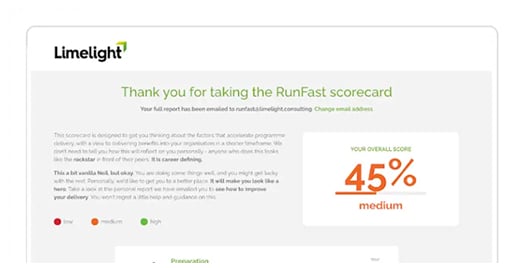
Take our free two-minute assessment and get an instant view of your COE readiness — across IT capability, support structure, role definition, and continuous improvement maturity.
What's delivered. Every time.
1
A Centre of Excellence that actually works
The right blend of IT and business process expertise — designed around your organisation's size, ambition, and SAP landscape. Not a generic COE template dropped in from a methodology.
Outcome
An internal capability built to last.
2
Clear roles, clear ownership
Role definitions, capability frameworks, and responsibilities embedded across every COE function — so your teams know what they own, how to run it, and how to improve it.
Outcome
No dependency on individuals. No knowledge gaps.
3
A support model ready for go-live and beyond
IT support processes validated against your systems, your users, and your ways of working — with a continuous improvement framework that keeps delivering value after the programme team has left.
Outcome
SAP running well. Getting better.
4
Governance
Best practice governance frameworks for the support organisation. Clear definition on the roles and responsibilities for all involved in the governance process.
Outcome
Strong governance with defined roles and accountability
5
Best practice tooling and methodologies
Making the most of SAP standard tooling and methodologies.
Outcome
Effective use of SAP tools and methodologies
6
Operational aspects of the COE
Best practice guidelines and templates
Outcome
Standardised operational guidelines and templates
7
Continuous improvement methodologies
Outcome
Continuous improvement through structured performance reviews
Powered by Prism
- Live programme visibility
- Business focussed interface
- Tracking and Readiness checks
- Board-ready reporting
- From day one of your transformation delivery
RunCentre Setup in action.
Harrods had been an SAP customer for twenty years. The technology had served the business well — but the leadership team recognised it was time to modernise, taking full advantage of the latest SAP capabilities to support the next phase of the business.
The Future Retail programme was a complete greenfield reimplementation of the entire Harrods SAP footprint — a full redesign of retail, supply chain, and financial processes, delivered against an aggressive timeline of under eighteen months.
Where does RunCentre Setup fit?

Start your programme right
Haven't started yet? RunFast Launchpad gets your programme transformation-ready before the SI is engaged — business case, scope, and foundations in place.

Deliver your programme
You've completed Launchpad. Now deliver. Full programme governance, SI management, and client-side leadership throughout implementation.
Sustain the value after go-live
Already live and looking to keep improving? RunBetter helps you optimise processes and sustain the value of your SAP investment long term.

Latest insights
Questions we get asked.
A Centre of Excellence (CoE) is the internal capability that owns your SAP landscape after the transformation programme ends. It governs the system, owns business processes, manages user support, drives continuous improvement, and handles future change requests. Without a CoE, transformation investment erodes as changes are made without governance and institutional knowledge walks out.
Whether you need one depends on the scale of your SAP investment and the pace at which your business needs to adapt the system. For most organisations that have completed a major SAP transformation, the answer is yes.Ideally, CoE design begins during the transformation programme — not after it. Waiting until go-live means the most experienced people leave before knowledge is transferred, governance structures are not in place when the system goes live, and the organisation loses momentum at exactly the moment it should be building on it.
Limelight recommends treating CoE establishment as a programme workstream in its own right — with a defined operating model, resource plan, and capability framework agreed before the programme team winds down.A CoE typically combines internal and external capability. Internally, it is led by a senior process or technology owner with authority across business functions, including process owners for key functional areas, a small technical team, and a governance function for change requests. The balance between in-house and outsourced depends on SAP landscape complexity and pace of expected change.
Limelight designs CoE operating models that are fit for purpose — not templates from a previous engagement. The model needs to match the organisation's size, complexity, and strategic ambition.Our goal is not to create dependency. RunCentre Setup transfers capability to your organisation through structured knowledge transfer, documentation of decision frameworks, coaching of internal team members, and a phased handover that maintains quality while building internal confidence.
We measure the success of RunCentre not by how long we stay engaged — but by how capable your team is when we leave. This is the opposite of the model most consultancies operate on.The first step is a structured consultation — typically sixty to ninety minutes — in which we understand your programme's current position, objectives, and the specific challenge you are trying to solve. We will be direct about whether and how Limelight can help. There is no commitment required and no proposal pushed before that conversation.
Most engagements begin with RunFast Launchpad for organisations at the start of their journey, or a RunHealthy Assessment for programmes already running. We will tell you clearly which starting point fits your situation — including if neither is right for you.RunCentre Setup typically runs over eight to twelve weeks, depending on the size and complexity of your organisation and SAP landscape. The engagement is structured to align with your go-live timeline — so the support model and COE are ready to operate from day one, not retrofitted afterwards.
The eight to twelve week timeline covers the full scope — IT capability review, support model design, role definition, COE structure, and continuous improvement framework. Where organisations engage Limelight earlier in the programme, some of this work can run in parallel with delivery, compressing the timeline and ensuring the COE is embedded before the programme team leaves rather than built after they have gone.
Yes — and starting earlier produces better results. The most common mistake is treating COE design as a post-go-live activity. By the time the programme ends, the knowledge, relationships, and momentum needed to build a strong COE are already dispersing.
Limelight recommends beginning RunCentre Setup in the final stages of delivery — typically three to four months before go-live. This allows the COE structure to be designed with the programme team still in place, roles to be defined before handover, and the support model to be tested before it needs to operate under real conditions. Organisations that start RunCentre Setup early consistently achieve a smoother transition and a more capable internal team on day one.